




Contact us
Your License. Our Fight.
Get a free initial consultation for your traffic, criminal, and personal injury matters.

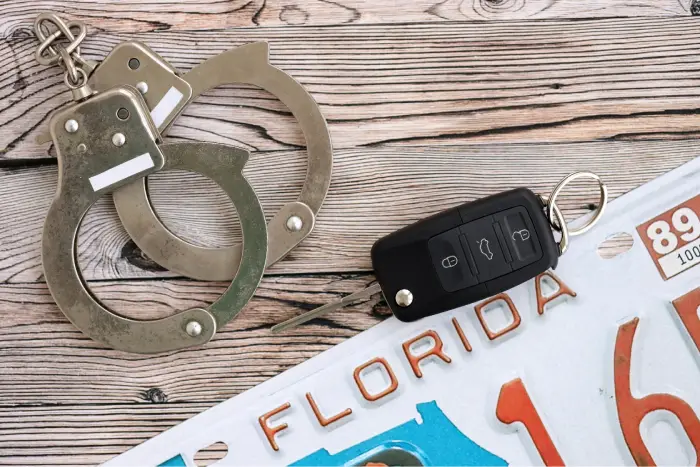
Planning a road trip to Florida? Or maybe you’ve booked a flight intending to rent a car. Either way, if you plan to drive around in the Sunshine State, it’s a good idea to check what the Florida driving laws are.
The last thing you want is a traffic ticket, or worse, to have your sunny vacation clouded. To help you avoid violations on your vacation, we’ve compiled a list of the most important Florida driving laws. Keep reading to learn more.
The driving rules in Florida aren’t much different from those in other states, but that doesn’t mean there aren’t any unique ordinances you should be aware of. After all, the state is full of visitors from all over the world, each with a different driving style. Not to mention, there’s an incredibly large number of drivers over the age of 65.
You also have to take into account how many people visit Florida year-round, as well as those who are recent transplants for work or school. etc. It’s a state that’s got a lot going on, which can leave the roadways vulnerable.
That’s why the Florida driving laws are as follows:
In 2013, the state law allowing foreigners to use their regular driver’s license changed. Now, all foreign drivers must obtain an international driver’s permit from their country before visiting.
It’s not illegal to drive in Florida while talking on your phone. However, if you get into an accident while talking on your phone, you could be subject to a penalty under the state’s distracted driving laws.
Texting, on the other hand, is a big no-no. If you are caught texting while driving, it’s treated as a noncriminal traffic violation—if it’s the first offense. If you get caught texting and driving for the second time, it becomes a moving violation.
It should also be noted that police officers can now pull you over if they think you’re texting.
The state of Florida has a “Move Over” law. The law requires that when police officers are parked along interstates or multi-lane roads, you must move your car to the lane farthest from them. This law also includes emergency vehicles, tow trucks, and utility and sanitation vehicles. You must also slow down to 20 mph or less when passing.
It’s true—you can be ticketed for driving too slowly in Florida. Driving significantly below the speed limit is considered dangerous because it can cause accidents. So, drive the speed limit and move with the flow of traffic.
Everywhere in Florida, except on interstate and major highways, bicycles are considered motor vehicles. That means that on public roads, cyclists must also adhere to Florida driving laws. It also means that drivers in real motor vehicles must share the road.
In Florida, as long as you come to a complete stop at a red light and there’s no one coming, you can make a right turn. Unless, of course, there’s a sign posted that says otherwise.
FYI: A red light arrow also counts as a “no turn on red” sign.
You must wear a seatbelt while driving in Florida. Those caught driving without a seat belt used to receive a citation only if they were pulled over for something else. Now, just like the texting laws, drivers not wearing seat belts can be pulled over and issued a non-moving traffic violation.
This also holds true for not having the proper car seat for children under five and minors. Everyone under 18 in the car must wear their seat belt, regardless of where they’re sitting. Children under five must be seated in a car seat.
It’s not a legal requirement; however, Florida is stacked with nearly 500 miles of toll roads. Some of these tolls are unmanned, meaning you’ll need exact change in order to pass. The SunPass is a small device you attach to your windshield, connected to a prepaid account, allowing for quicker and safer toll road passage.
If you pass through a SunPass toll without the physical pass or an unmanned booth without exact change, you will be subject to a fine.
You will encounter red light cameras at every major intersection in the state of Florida. Some will even creep up on you in regular intersections. They’re there to help law enforcement catch people running red lights and committing other road infractions. So, be sure to follow Florida road rules; otherwise, you’ll end up with a surprise citation in the mail a month or two later.
There are thousands of places to go and things to see in the Sunshine State. By adhering to Florida driving laws, you can enjoy your trip without incurring any extra costs from traffic violations.
Of course, if you do end up with a traffic violation, reach out to us. We specialize in fighting against traffic violations, keeping your insurance rates low and your license point-free.